
Tankless vs. Tank Water Heater: Which One Actually Fits Your Home
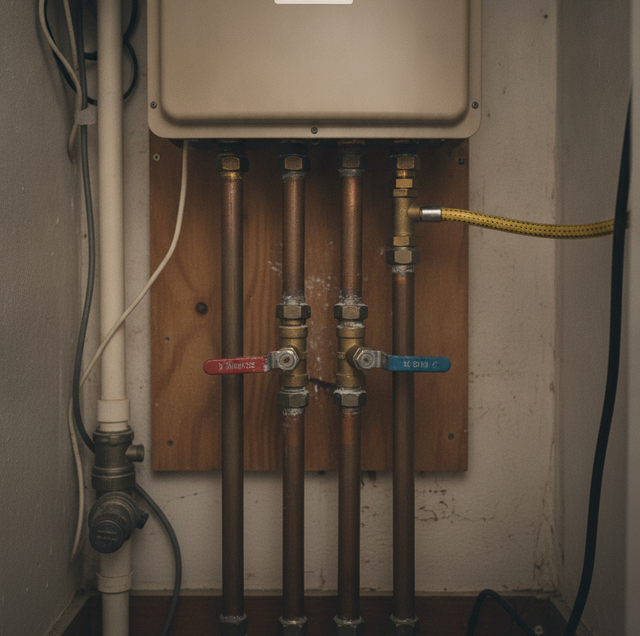
Quick Answer: A tank heater stores 40 to 50-plus gallons of hot water so it delivers a big burst instantly but can run dry during heavy back-to-back use. A tankless heater has no tank and heats water on demand, so it never runs out but is limited by flow rate. Pick a tank for high simultaneous demand and simpler installs; pick tankless for endless hot water, a smaller footprint, and longer service life, if your gas line or electrical panel can support it.
Standing in a cold shower because the last two people used up all the hot water is a familiar complaint. So is opening a utility closet and finding a bulky tank hogging half the space. Both problems point back to the same decision: the kind of water heater you own. Tank and tankless heaters do the same job in two very different ways, and the right choice depends on how your household actually uses hot water, not on which one sounds newer.
Here is how each one works, where each one struggles, and how to match the machine to your home.
How a Tank Water Heater Works
A storage tank heater is the familiar cylinder most homes have. It holds 40 to 50 gallons or more of water and keeps that entire volume hot around the clock. When you open a hot tap, pre-heated water flows out of the top of the tank while cold water enters the bottom, and a gas burner or electric element fires to reheat the incoming supply.
Because the tank always maintains a large reserve, it can deliver a large surge of hot water the instant you need it. That is its strength: fill a deep tub, run a load of laundry, no waiting. The catch is that the reserve is finite. Once you drain the hot water faster than the burner can reheat it, you get lukewarm, then cold. How much you can pull before that happens is described by the first-hour rating, and how fast the unit catches back up is the recovery rate.
The second drawback is quieter but constant. Keeping 50 gallons hot 24 hours a day means the tank loses heat to the surrounding air even when no one is using water, and the burner cycles on to replace it. That wasted energy is called standby loss, and you pay for it whether you take a shower or not.
How a Tankless Water Heater Works
A tankless, or on-demand, heater has no reservoir at all. When you open a hot tap, water flows through a heat exchanger, a set of coils that a powerful gas burner or electric element heats almost instantly, and hot water comes out the other side for as long as the tap stays open. Close the tap, and the unit shuts off. There is no stored volume to run dry, so a correctly sized tankless heater delivers effectively endless hot water and produces almost no standby loss.
The trade-off is flow rate. A tankless heater can only raise the temperature of so many gallons per minute (GPM). Ask it to supply more fixtures at once than its rating allows, and it cannot heat all that water enough, so the temperature at each tap drops. A tank answers "how much hot water total?"; a tankless answers "how much at the same moment?"
Think of it like a highway. A tank is a parking garage full of cars ready to leave all at once, but only as many as are parked. A tankless is an on-ramp feeding a steady stream of new cars, which never empties, but only so many lanes wide.
Tank vs Tankless: The Practical Comparison
| Factor | Tank (storage) | Tankless (on-demand) |
|---|---|---|
| Hot water supply | Big instant burst, then can run out during heavy use | Endless, but limited by flow rate (GPM) at any one moment |
| Footprint | Large floor-standing cylinder | Small unit, usually wall-mounted |
| Lifespan | Roughly 10 to 12 years typical | Often around 20 years, hedged by upkeep |
| Standby loss | Yes, reheats stored water around the clock | Minimal, heats only when water flows |
| Maintenance | Flush sediment, check the anode rod | Periodic descaling and flushing of the heat exchanger |
| Install | Usually a like-for-like swap | May need an upsized gas line, new venting, or a 240V circuit |
What Drives the Decision
Four questions settle most of these choices.
Household size and simultaneous demand come first. A larger household running two showers, a dishwasher, and a washing machine close together needs either a tank sized generously by first-hour rating or a tankless sized by GPM and temperature rise to handle everything at once. Temperature rise matters because a heater has to lift the incoming water to your target temperature, and the colder the incoming supply, the fewer gallons per minute a given tankless can deliver.
Space is the next factor. A tank needs floor area and clearance. A tankless unit mounts on a wall and frees up a closet or garage corner, which is a real advantage in a smaller home.
How long you plan to stay changes the math on lifespan. A tank typically lasts 10 to 12 years; a tankless system often runs closer to 20 years with proper upkeep, largely because a scaled or failed component can be serviced rather than replaced as a whole. If you are moving soon, the longer service life matters less to you than to the next owner.
Water hardness is a factor people often overlook, and it is a real issue in hard-water areas. Hard water carries dissolved minerals that leave scale behind wherever water is heated. In a tank, scale settles as sediment on the bottom. In a tankless system, it coats the narrow passages of the heat exchanger, where it chokes flow and forces the burner to work harder. A tankless water heater in a hard-water home needs descaling on a regular schedule to maintain its performance and reach that long lifespan.
Installation Realities Worth Knowing
A tank replacement is often close to a like-for-like swap, which keeps the job simpler. A tankless system can ask more of your home. A gas tankless fires far harder than a tank burner, so it frequently needs an upsized gas line and its own sealed venting. An electric tankless draws heavily and may require one or more dedicated 240V circuits, and in an older home, that can mean an electrical panel upgrade. These are one-time considerations, but they belong in the decision before you commit, not after.
Frequently Asked Questions
For a continuous draw, yes, as long as you stay inside its flow-rate limit. What surprises people is the "cold-water sandwich": if you shut a hot tap and reopen it seconds later, a slug of water that entered the exchanger while it was off arrives cool before the burner catches up, giving a brief cold patch between two warm ones. It smooths out on a steady flow but shows up with quick on-off use.
Often, yes, for one of the two. A gas tankless unit burns at a much higher rate than a tanked unit, so the existing gas line is often too small to supply it and needs upsizing, along with dedicated venting. An electric tankless pulls enough current that it usually needs one or more 240V circuits, and an older panel may not have the capacity, which means a panel upgrade. This is why a tankless install is rarely a simple swap.
Hard water deposits scale inside the heat exchanger's narrow channels, restricting flow and causing the burner to run hotter and longer to reach your target temperature. Left alone, the scale shortens the unit's life and can trigger error codes. Most homes with hard water benefit from a descaling flush about once a year, and harder water or heavier use may require it more often. A water softener or a scale-reducing setup upstream stretches the interval.
A tankless system typically lasts around 20 years, compared to roughly 10 to 12 years for a tank, though these figures are general expectations rather than guarantees. The difference is in the parts. A tank relies on a glass-lined steel shell and a sacrificial anode rod that corrodes in place of the tank; once the anode is spent, the steel starts to rust, and the tank eventually leaks and must be replaced whole. A tankless unit has no standing reservoir to corrode, and its heat exchanger and key components can be serviced or replaced, so it keeps going longer, provided you keep scale in check.
Only if it is sized for it. Two showers might draw around 3 to 5 GPM combined, and the unit has to supply that while lifting cold incoming water to shower temperature. That combined flow-plus-temperature-rise demand is exactly what tankless sizing is built around, and a unit chosen for a single bathroom will run warm on two. Homes with high simultaneous demand need a larger unit, more than one in parallel, or a generously sized tank instead.
The strongest tankless advantages, longer lifespan and lower standby loss, pay back in years, so a shorter stay leaves less time to recover the higher install cost and any gas or electrical work. If you are moving soon, a tank system often makes more practical sense, though a tankless system can still appeal to the next owner. If you plan to stay put and value endless hot water and reclaimed space, the longer horizon works in your favor.
Talk through the right water heater for your household and setup — get sizing and install answered before you buy. Done Right Drains and Plumbing serves Chula Vista, San Diego, National City. Call (619) 737-3274.
