
What a Pressure Regulator Does and Why It Protects Your Pipes
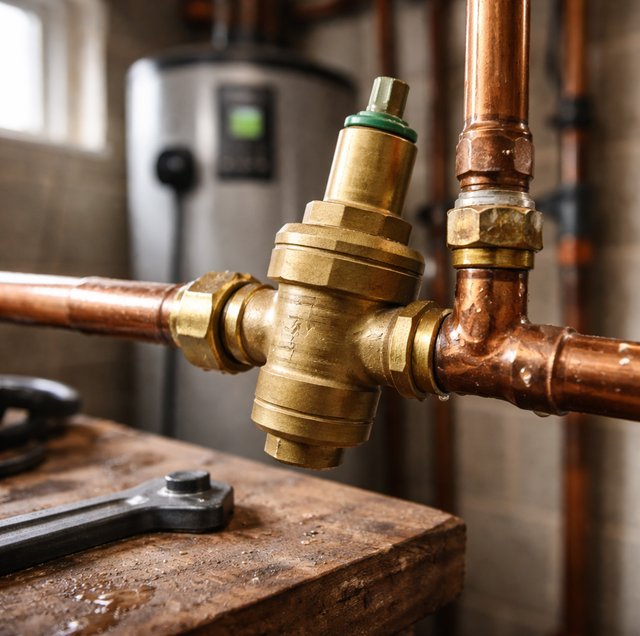
Quick Answer: A pressure regulator (PRV) is a valve installed where water enters the home that lowers high municipal pressure to a safe household range, usually about 50 to 60 psi. It protects pipes, joints, fixtures, and appliances from constant stress, and it keeps the system from being pushed harder than it was designed for.
Water arrives at your home under pressure supplied by the municipal main, and that pressure is set for the whole neighborhood, not for your fixtures. On many streets it runs higher than a house is built to handle. A pressure regulator, also called a pressure-reducing valve or PRV, is the brass fitting that steps that incoming pressure down to a level your plumbing can live with day after day.
Before getting into where the valve sits and how it fails, it helps to understand what water pressure actually is and why too much of it works against everything downstream.
What Water Pressure Is and Why Too Much Hurts
Water pressure is the force pushing water through the pipes, measured in pounds per square inch (psi). You feel it every time a faucet opens: higher pressure means a faster, harder flow. A little force is good, because it gets water to upstairs bathrooms and pushes it through fixtures at a usable rate.
The problem is that force does not switch off when the tap closes. It presses constantly on every pipe wall, every soldered or threaded joint, every rubber washer, and every valve seat in the house. Household plumbing is generally designed to run comfortably in the 40 to 60 psi range. Push past roughly 80 psi and that constant load starts wearing parts out faster than they should.
Think of the pipes behind your walls as a system holding its breath all day. At a reasonable pressure, it holds easily. At high pressure, it is straining every second, even overnight when no one is using water, and the weakest fitting is the one that eventually gives.
That is the job a PRV exists to do. It sets a ceiling. However hard the street pushes, the valve holds the house side at the level it was adjusted to.
Where the PRV Sits in the System
A pressure regulator lives near the point where the water supply enters the building, close to the main shutoff valve and the meter. In a home with a crawlspace or basement, it is often just inside the wall where the line comes in. On a slab home, it is frequently outside near the meter or in a box at the front of the property.
It looks like a bell-shaped or dome-shaped brass body sitting in line on the main pipe, usually with an adjustment screw and locknut on top. Water flows in from the street side, passes through an internal spring-loaded seat that restricts and steadies the flow, and leaves at the reduced pressure the valve is set to hold.
Because it sits on the main line, a single PRV protects the entire house at once: every faucet, the water heater, the dishwasher, the washing machine, and the irrigation valves all sit downstream of it.
Signs Your Pressure Is Too High
High pressure rarely announces itself politely. It shows up as a scatter of small problems that seem unrelated until you connect them:
Banging or hammering pipes: A loud knock when a faucet or appliance valve shuts off is often water hammer, and high pressure makes it far worse because the moving water carries more force to slam to a stop.
Toilets that run or refill on their own: Excess pressure pushes past the fill valve and flapper, so a toilet trickles or cycles when no one has touched it.
Fixtures and appliances wearing out early: Faucet cartridges, supply hoses, fill valves, and the internals of a dishwasher or washing machine all fail sooner when they hold back more force than they were rated for.
A dripping water heater relief valve: The temperature and pressure relief valve on the water heater may weep or discharge when system pressure climbs too high.
Recurring leaks at joints and hoses: A rubber washer or braided supply line that keeps failing, or a joint that seeps after every repair, can point back to pressure rather than the fitting itself.
A homeowner can confirm the number safely. Screw an inexpensive water-pressure gauge onto an outdoor hose bib, open that faucet fully, and read the dial. A reading well above 80 psi means the house is running too hard and either has no working regulator or has one that needs attention.
You can check your home's pressure yourself. Thread an inexpensive water-pressure gauge onto an outdoor hose bib, open that faucet fully, and read the dial. Anything well above 80 psi means the house is running too hard and the regulator is missing or needs attention.
How to Tell a PRV Has Failed
A regulator is a mechanical part with an internal spring and seat, and those wear. When one starts to fail, the pressure stops behaving the way a healthy valve keeps it:
- Pressure creeps up over time: The valve slowly loses its ability to hold the line down, so readings drift higher over weeks or months even though nothing else changed.
- Pressure drops too low: A regulator can also fail closed, choking flow so showers go weak and filling a tub takes far longer than it used to.
- Pressure swings: A reading that jumps around, strong one minute and soft the next, points to a worn seat that can no longer hold a steady setting.
The gauge test on a hose bib is the quickest way to catch this. Watching how the number sits, and whether it climbs after the house has been quiet for a while, tells a plumber a lot about whether the valve is still doing its job.
Why This Matters for Appliances and Warranties
The stakes go past nuisance leaks. Manufacturers of water heaters, dishwashers, and washing machines commonly state a maximum inlet pressure in their installation instructions, often around 80 psi. Running an appliance above that limit can void the warranty, because the maker will not cover damage caused by feeding it more pressure than the specification allows.
A working PRV is what keeps a home inside those limits without anyone thinking about it. Replacing a failed water heater or a warped appliance valve costs far more than keeping the regulator that protects them in good order.
The PRV and Thermal Expansion Work Together
Installing a regulator changes the plumbing in a way worth understanding. A PRV includes a check feature that stops water from flowing back toward the street. That turns the home into what plumbers call a closed system: water can come in, but heated water cannot push back out the way it could before.
Water expands as it heats in the water heater, and in a closed system that extra volume has nowhere to go. Pressure spikes each time the heater runs. The standard answer is a thermal expansion tank, a small tank near the water heater with an air cushion that absorbs the expansion and keeps those spikes from stressing the system.
This is why a PRV and an expansion tank are usually installed as a pair. Adding a regulator to a home that lacks an expansion tank can create pressure spikes on the water heater that were not there before, which is one reason the work belongs with a plumber who will check for both.
Adjustment and Replacement Basics
A PRV is adjustable within a range. Loosening the locknut and turning the adjustment screw raises or lowers the target pressure, and a plumber sets it by watching a gauge while turning, dialing the house into a safe band rather than guessing. Small drift can sometimes be corrected with an adjustment. Once the internal spring and seat are worn, though, no amount of turning holds a steady setting, and the valve needs to be replaced.
Replacement means shutting off the main, relieving pressure, cutting or unthreading the old body out of the line, and fitting a new one with fresh thread sealant on the connections. Because it involves the whole-house shutoff and sealing pressurized joints, it is best handled by a plumber rather than treated as a quick homeowner swap.
There is a safety reason to act rather than wait. A regulator stuck open on a closed system with no working expansion tank lets pressure climb with nowhere to escape, which can push a water heater's relief valve to discharge repeatedly or, in a worst case, damage the tank. Rising pressure, a weeping relief valve, or a gauge reading that will not settle are reasons to call a plumber, not to keep adjusting the screw.
A regulator stuck open on a closed system with no working expansion tank lets pressure climb with nowhere to escape, which can push a water heater's relief valve to discharge repeatedly or, in a worst case, damage the tank. Rising pressure, a weeping relief valve, or a gauge reading that will not settle are reasons to call a plumber, not to keep adjusting the screw.
Frequently Asked Questions
Most PRVs last somewhere in the range of 7 to 12 years, though hard water shortens that. Mineral scale builds up on the internal seat and spring and keeps them from sealing cleanly, so a home with hard water may see a regulator wear out toward the lower end of that window even when everything was installed correctly.
No. A PRV is added only where incoming pressure is high enough to need reducing, so homes on lower-pressure supply lines may never have had one. Some older homes that should have a regulator lost it during past plumbing work and were never refitted, which is why a gauge test matters even if you have never seen a valve.
Turning the adjustment screw does change the setting, but weak flow often comes from a failing regulator, a clogged aerator, or a partly closed shutoff rather than a valve set too low. Cranking the screw up to force more pressure can push the whole house past safe limits and mask the real fault, so the setting is best changed against a gauge by a plumber.
A common target is around 50 to 60 psi, which gives strong flow while staying under appliance limits. The exact figure depends on the home's layout: a house with several upstairs bathrooms may be set toward the higher end so upper floors get enough force, while a single-story home can sit lower and still perform well.
Indirectly, sometimes. A regulator does not change the rate you pay per gallon, but lower pressure means less water pushed through every open faucet and less waste through slow leaks and running toilets, so a house that was running very high may use noticeably less after one is set correctly.
It helps, but it is not a complete fix. Lower pressure reduces the force behind the water, which softens the bang. True water hammer, the shock when a valve slams shut, is fully addressed by adding water-hammer arrestors near the offending fixtures, which give the moving water a cushion to stop against.
Get your home's water pressure checked before it costs you an appliance — a quick gauge test and PRV inspection can spare your pipes years of strain. Done Right Drains and Plumbing serves Chula Vista, San Diego, and National City. Call (619) 737-3274.
