
Why Is My Water Heater Leaking? 5 Sources, Ranked by Danger
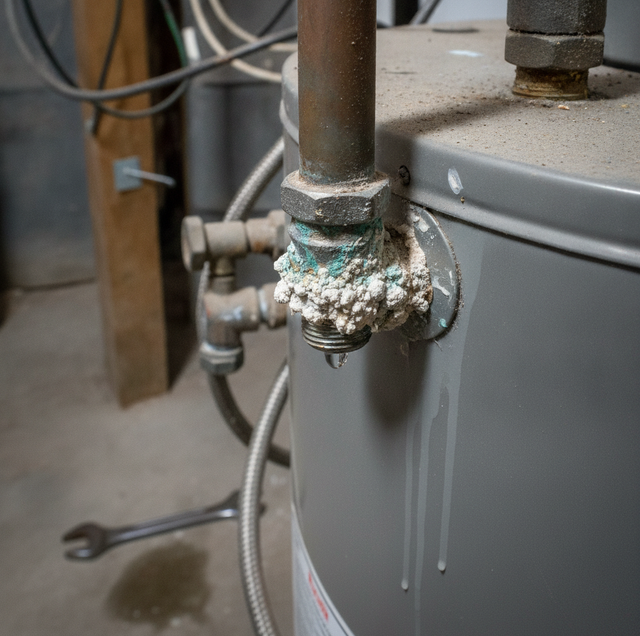
Quick Answer: A leaking water heater has several possible sources, and the location tells you how serious it is. From least to most serious: harmless condensation on a cold tank, a loose inlet or outlet fitting, a temperature-and-pressure (T&P) relief valve that is either doing its job or has failed, a dripping drain valve at the bottom, and worst of all, a leak from the tank body itself. A tank-body leak means internal corrosion has breached the steel, and that cannot be repaired, so the heater is replaced.
You walk into the garage or utility closet and find a puddle spreading under the water heater. Before you assume the worst, know this: not every drop of water near a water heater means the tank has failed. Some sources are harmless. Some are a quick repair. And one of them means the unit is at the end of its life and needs to be replaced. The trick is figuring out which one you have, and the water itself tells you most of the story.
Where the water is coming from matters more than how much of it there is. A tank can weep a slow, steady drip from a rusted seam and be finished, while a fitting can spray visibly and only need a wrench. This guide walks through the possible sources from top to bottom, from the harmless to the serious, so you can tell what you are looking at.
First, Confirm It Is Actually the Heater
The single most useful thing you can do is rule out everything above the water heater before you blame the heater. Water travels. A drip from an overhead cold-water line, a sweating supply pipe, a nearby washing machine hose, or a slow roof or wall seep can all pool under the tank and look exactly like a heater leak.
Dry the area completely with towels, then watch where the water reappears. Run your hand along the pipes feeding the unit and along the tank body. Put down a few sheets of paper or cardboard and check which ones get wet first. If the water shows up on top and runs down, the source is above the heater, not the heater itself. Only once you have traced the water back to the tank, a fitting on the tank, or a valve on the tank should you treat this as a water heater problem.
The Five Sources, From Harmless to Serious
Condensation
The most common false alarm. When cold water fills the tank, especially after heavy hot-water use, the outside of the tank can drop below the dew point of the surrounding air, causing beads of moisture to form. In a humid garage or a closet with poor airflow, that sweating can look like a leak. Condensation forms a light film across a wide area of the tank and disappears as the water inside warms back up. It leaves no growing puddle and never traces back to a single point.
A Loose or Failing Connection
Where the cold water comes in, and the hot water goes out, there are threaded fittings, and sometimes flexible connectors or dielectric unions. Vibration, thermal expansion from years of heating and cooling, and simple age can loosen or corrode these joints. A leak here appears right at a fitting, often with mineral crust or a green tint on the metal. This is usually the good news category. Tightening the connection or replacing the fitting or connector resolves the issue, and the tank is fine.
The T&P Relief Valve
Near the top or on the side sits the temperature-and-pressure relief valve, with a pipe running down toward the floor. This is a safety device, not a nuisance part. It is built to open and release water if the tank ever gets too hot or the internal pressure climbs too high. So water at the bottom of that discharge pipe means one of two things: the valve is opening because there is a genuine pressure or temperature problem to solve, or the valve itself has worn out and no longer seals. Either way, it points to something that needs attention, and the discharge pipe should never be plugged or capped.
The Drain Valve
At the very bottom of the tank is the drain valve, the spigot used to empty the tank for flushing or service. These are often made of plastic and can drip if they are slightly open, worn, or not seated tightly after a past draining. A drain valve leak is localized right at that fitting, low on the tank. It is a replaceable part, and swapping it does not mean the tank is bad.
The Tank Itself
This is the source you do not want. If water is seeping from a seam, a weld line, or the base of the tank rather than from any fitting or valve, the steel shell has corroded through from the inside. Think of the glass lining inside a water heater like the enamel on a cast-iron pan: once that protective layer chips and rust reaches the bare metal underneath, the damage spreads and cannot be undone from the outside. A tank leaking from its own body is failing, and no patch, sealant, or clamp holds reliably against water heated under pressure. This one means replacement.
Why the Anode Rod Explains So Much of This
To understand why a tank rusts from the inside, you have to know about the anode rod. It is a long metal rod, usually magnesium or aluminum, that threads into the top of the tank and hangs down inside. Its whole job is to corrode, not the tank. Because it is a more reactive metal, it draws the corrosive action of the water toward itself and away from the steel walls. That is why it is called a sacrificial anode: it is designed to be eaten away so the tank is not.
The catch is that the rod is a consumable. Once it is used up, nothing remains to protect the steel, and the tank begins to rust from the inside out. That internal corrosion is exactly what eventually breaches the tank wall, resulting in the worst-case leak. A rod that is inspected and replaced before it is spent can significantly extend a tank's life. A rod that is never checked is a quiet reason many tanks fail around the same age.
Why Age Changes the Answer
The unit's age shifts the odds. Many tank-style water heaters last eight to twelve years, though the exact lifespan depends on water quality, water hardness, whether the anode rod was ever serviced, and how heavily the unit was used. Hard water, common in many areas, scales the interior and speeds up wear, which can push a tank toward the lower end of that range.
Here is how age reframes what you are looking at. If a unit well into that eight-to-twelve-year window suddenly leaks from the tank body, corrosion has likely run its course, and replacement is the realistic call. If a two- or three-year-old heater is leaking, it is far more likely to be a fitting, a connector, or a valve, because the tank has not had time to rust through. Age alone does not diagnose the leak, but it tells you which explanation is more likely before you even get close to the unit.
Safety Comes Before Any Fix
A water heater combines two things that do not mix well with standing water: an energy source and heat. Gas models have a burner and a flue. Electric models have live elements and wiring. Water pooling around either is a real hazard, not a theoretical one.
If the unit is leaking badly or water is spreading toward electrical outlets, a gas control, or a burner area, shut off the power or gas to the heater and close the cold-water supply valve feeding it. On an electric unit, that means the breaker; on a gas unit, turn the gas control off. Closing the supply valve stops more water from feeding the tank. Keep in mind that water from the T&P discharge line can be scalding hot, so do not put your hand under it to check.
Tightening an accessible fitting or closing a supply valve is within most homeowners’ reach. Diagnosing a T&P valve, working on gas connections, and replacing a tank are not do-it-yourself territory. Those involve pressure, combustion, and code considerations that call for a licensed plumber. When the source is the tank body, the only real answer is a professional replacement.
Frequently Asked Questions
A single drip after a hot cycle can be routine, but repeated dripping often traces to thermal expansion in a closed system. When a check valve or a pressure-reducing valve on the incoming line prevents water from flowing backward, the water has nowhere to go as it heats and expands, so pressure builds and is released through the relief valve. The correct fix in that case is a thermal expansion tank that gives the expanding water a cushion to absorb into, not capping the valve, which would only bottle up the pressure it was built to release.
Condensation appears as light sweating across the outside of the tank, and it dries off as the water inside heats and the tank surface warms above the dew point. A real leak behaves differently: it produces a growing puddle or a steady drip that you can trace to a specific spot, whether that is a fitting, a valve, or the base of the tank. If you dry everything and moisture returns at a single identifiable point, it is a leak; if a thin film appears broadly and then vanishes as the unit heats, it is condensation.
The anode rod is a sacrificial metal rod that corrodes in place of the steel tank, and its lifespan depends heavily on the water running through it. A good habit is to pull and check it every few years rather than wait for a failure. Softened water is worth a special note here: the salt and sodium in it actually speed up how fast the rod is consumed, so a home with a water softener may need the rod replaced sooner than a home without one to keep the tank protected. Catching a spent rod before it is fully gone is what prevents the corrosion from spreading to the tank wall.
No, but first confirm the water is truly coming from the tank, not from a fitting above it. Dry everything with towels and watch where the water returns: if it reappears at a seam or the base of the shell rather than at a joint, the steel has corroded through, and no patch holds against heated, pressurized water. Before you buy a replacement, check whether the unit is still under warranty, because the manufacture date sets the coverage window, and a tank that fails within that window may be covered. Either way, the tank is swapped out rather than patched.
The exact spot is what separates a cheap fix from a replacement. The drain valve at the base can drip if it is loose, worn, or not fully closed after a previous flush, and it is a replaceable part. But if the water is seeping from the seam or the base of the tank shell rather than from the valve spout, that points to internal rust and a failing tank. Looking closely at whether the water originates at the valve or the tank body itself tells you which situation you are in.
It is one of the best early clues, and you can find the age even on a heater you did not install yourself. The manufacture date is encoded in the serial number stamped on the rating plate: on many brands, the first digits give the week and year the unit was built, while others use a letter code for the month or year. Decode that, and you can see where the heater falls in the eight-to-twelve-year window. A unit near the top of that range leaking from the body is likely spent, whereas a young unit leaking is far more often a fitting or valve that has not had time to rust through.
Book a licensed plumber to find the source and fix it right — protect your home from water damage and get honest answers. Done Right Drains and Plumbing serves Chula Vista, San Diego, National City. Call (619) 737-3274.
