
Why Your Tankless Water Heater Goes Cold Mid-Shower
Quick Answer: A tankless heater going cold usually traces to one of a few causes: a short cold burst when the unit restarts (the cold-water sandwich), demand that exceeds its flow-rate and temperature-rise capacity, scale coating the heat exchanger, a clogged inlet filter, a gas-supply or venting fault that drops the burner out, or hot water crossing over into the cold line through a failed mixing valve. Cleaning the inlet screen and running a manufacturer descale handle the two most common causes; gas, venting, and error-code faults call for a licensed plumber.
A tankless water heater is supposed to end cold showers, so it feels like a betrayal when the water goes warm, then cold, right in the middle of one. The unit is not necessarily broken. Tankless heaters heat differently than tank models, and that difference creates a handful of specific ways the hot water can drop out. Knowing which one you are dealing with tells you whether it is a five-minute cleaning, a descale, or a call to a plumber.
This walks through how a tankless unit makes hot water on demand, the common ways that process stalls, and what actually fixes each one.
How a Tankless Unit Heats on Demand
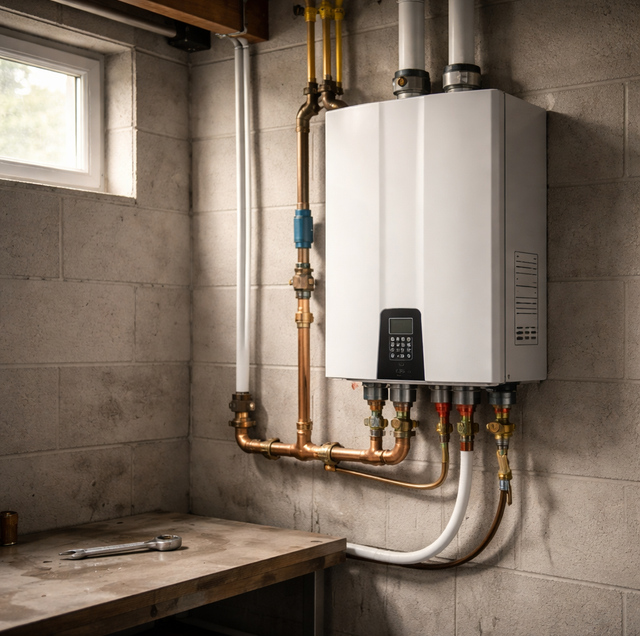
A tankless, or on-demand, heater keeps no reservoir of hot water. When you open a hot tap, water starts moving through the unit, and a flow sensor detects it. That sensor tells the control board to fire the gas burner, which heats a heat exchanger, a dense set of coils the incoming water flows through. The water leaves the exchanger hot and travels to your tap. Close the tap and the flow stops, the sensor registers zero, and the burner shuts off.
Two numbers govern everything the unit can do. The first is flow rate, measured in gallons per minute (GPM): how much water is moving through at once. The second is temperature rise: how many degrees the burner has to add to bring the incoming water up to your set temperature. A tankless heater has a fixed maximum heating output, so those two numbers trade against each other. Ask for a high flow rate and a large temperature rise at the same time, and the unit runs out of capacity. That single fact explains several of the cold-water problems below.
The Cold-Water Sandwich
The most common cold surprise is not a fault at all. If someone shuts off a hot tap and another person opens one a few seconds later, the slug of water sitting in the pipe between the heater and the tap has already cooled. You get hot water, then that pocket of cooled water, then hot water again, a warm-cold-warm sequence known as the cold-water sandwich.
It happens because the burner takes a moment to sense flow, fire, and bring the exchanger back up to temperature after each restart. The longer the pipe run and the more often the tap cycles on and off, the more noticeable it gets. This is normal tankless behavior, not damage. A dedicated recirculation loop or a small buffer tank smooths it out, and a unit with a built-in recirculation feature reduces it. If the cold stretch lasts only a couple of seconds when a tap restarts, you are almost certainly looking at a sandwich, not a failure.
Exceeding Flow and Temperature-Rise Capacity
The next cause is asking the unit for more than it can heat. Run a shower, the dishwasher, and a kitchen tap at once, and the combined GPM can pass what the heater is rated to warm. When flow outruns capacity, the burner cannot add enough heat to all that water, so the temperature at every open tap sags.
Colder incoming water makes this worse because it raises the temperature rise the burner has to cover. Groundwater is colder in winter, so the same unit that kept up all summer can fall short on a cold morning. This is two-sided, though: winter inlet temperature lowers capacity, but a growing household, added fixtures, or a new soaking tub push demand up the rest of the year too. If the heater only goes cold when several fixtures run together, the unit may simply be undersized for the home rather than defective. A plumber sizes a replacement by adding up the GPM of the fixtures you actually run at once and checking that against the coldest inlet temperature.
A quick way to tell demand from a fault: Turn off every hot fixture but one and run it alone. If a single shower stays hot but adding a second draw cools it, the issue is capacity or sizing. If one lone fixture still goes cold, the problem is inside the unit.
Scale on the Heat Exchanger
Hard water is the slow killer of tankless output. As water heats inside the exchanger, dissolved calcium and magnesium drop out of solution and cling to the coil walls as scale. That mineral layer insulates the exchanger, so the burner's heat no longer transfers efficiently into the water. Output drifts down, temperatures wander, and the unit works harder for a weaker result.
The fix is descaling: circulating a descaling solution or white vinegar through the exchanger with a pump to dissolve the buildup. Many units have isolation valves already installed for exactly this. On hard water, the exchanger benefits from a regular flush, and a whole-home softener slows scale from forming in the first place. A homeowner comfortable with the procedure can run a manufacturer-approved descale following the maker's instructions; if the unit has no isolation valves or the water is very hard, a plumber can handle it and add the valves.
A Clogged Inlet Filter
Most tankless units have a small inlet screen or filter where cold water enters, meant to catch sediment, grit, and pipe scale before it reaches the exchanger. Over time, that screen loads up. A partially blocked screen chokes the flow reaching the burner, which can starve the unit and cause erratic or dropping temperatures, sometimes read by the control board as low flow.
Cleaning the inlet screen is the one tankless fix most homeowners can safely do. Shut off the water and close the isolation valves, remove the inlet filter per the manual, rinse the debris out, and reseat it. A screen that clogs solid after only a few months points to heavy sediment worth having looked at.
Gas Supply and Venting Faults
A tankless burner demands a strong, steady gas supply because it fires hard and fast when a tap opens. If the gas line is undersized, shared with other hungry appliances, or the supply pressure sags, the burner may fail to reach full output or drop out mid-draw, and the water goes cold. Propane units can show this as the tank runs low.
Venting matters just as much. A tankless heater has to exhaust combustion gases and pull in combustion air. A blocked, disconnected, or improperly pitched vent can trip the unit's safety controls and shut the burner down for protection.
Gas supply, gas-line sizing, combustion air, and venting are licensed-plumber and gas-professional work, not homeowner repairs. Never disable or bypass a safety lockout to keep a unit running, because those controls are what prevent a combustion hazard.
Recirculation and Crossover Issues
If your hot water is lukewarm at every tap and never gets properly hot, suspect a crossover. In homes with a single-handle or thermostatic mixing valve, or a recirculation system, a worn or failed valve can let cold water bleed backward into the hot line. The heater is working, but its hot output is being diluted by cold before it reaches you, so nothing feels right.
A simple field check: with the water heater running, feel the cold-water pipe near a mixing valve. If it turns warm while only a hot tap is open, hot water is crossing into the cold side, and a valve is the likely culprit. Crossover also confuses the flow sensor in low-flow moments, adding to the cold spells. Isolating and replacing the failed cartridge or valve restores separation between the hot and cold lines.
When an Error Code Means Call a Pro
Modern tankless units self-diagnose and flash a numeric error code on the display when they detect a fault, ignition failure, flame loss, overheating, a flow-sensor problem, or a venting error. Write the code down before you reset anything; it tells a plumber exactly where to look and saves diagnostic time.
You can safely handle the homeowner-level causes: cleaning the inlet screen and running a manufacturer descale if you are comfortable with the steps. Repeated lockouts, any ignition or flame-loss code, anything involving gas or venting, or cold water that returns right after a reset all mean the unit needs a licensed plumber. A pro can read the fault history, test gas pressure and combustion, and repair the exchanger or controls safely rather than masking a warning.
Frequently Asked Questions
The pocket of cooled water forms as soon as flow stops and the pipe sits idle, but it becomes noticeable after roughly a minute or more of the tap being off, longer if the run to the fixture is short and well insulated. Draws spaced only seconds apart tend to blend together, while a stop-start pattern of a minute or two produces the clearest warm-cold-warm swing.
No. A softener prevents new scale by removing the calcium and magnesium before the water reaches the unit, but it does nothing to the crust already bonded to the coils. Existing scale still has to be dissolved with a descaling flush. Pairing a fresh descale with a softener afterward is the combination that keeps the exchanger clean going forward.
On typical water, once a year is common; on hard water, every six months keeps output steady. The clearest signal is behavioral: if you notice the unit taking longer to heat or drifting in temperature between flushes, move the schedule up rather than waiting for the calendar.
Outdoor and garage-mounted units have built-in freeze protection that draws power to keep internal components above freezing. In a power outage during a hard freeze, that protection stops working, and the exchanger or water lines can freeze and crack, which shows up later as no hot water or a leak. Keeping the unit powered in cold snaps and insulating exposed supply lines prevents it.
Most tankless units have a minimum activation flow, often around half a gallon per minute, below which the flow sensor never tells the burner to fire. A barely-open faucet or a low-flow fixture can fall under that threshold, so the water runs cold because the heater never turned on. Opening the tap wider past the minimum brings the burner online.
Yes, and it is a common answer for high-demand households. Many tankless models are designed to link in parallel with a manifold, so a second unit adds its GPM capacity and the pair share the load and stagger their firing. A plumber sizes the combined system to the home's peak simultaneous demand, which solves undersizing without forcing every fixture onto one exchanger.
Book a tankless diagnostic and flush — restore steady hot water and catch scale before it costs you the unit. Done Right Drains and Plumbing serves Chula Vista, San Diego, and National City. Call (619) 737-3274.
